What is restaurant Growth Intelligence?
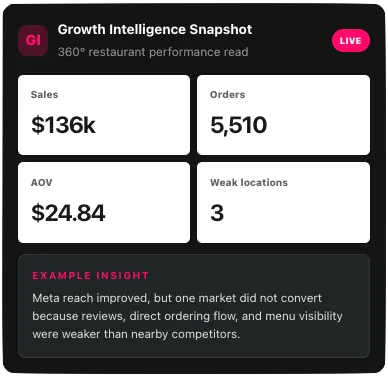
Restaurant Growth Intelligence is not just analytics. It is the practice of reading restaurant performance from every important angle and explaining what is really helping or hurting growth.
For a restaurant brand, growth is rarely caused by one thing. Sales may move because of paid ads, local search visibility, social media, customer retention, a stronger offer, a better menu layout, better reviews, a franchisee issue, a delivery-channel shift, or a competitor running a better promotion nearby.
Growth Intelligence helps restaurants understand why sales moved, which locations are affected, and what action should happen next.
This is especially important for QSRs, fast casual brands, cafés, franchise systems, and multi-location restaurant groups because brand-wide numbers can look healthy while certain locations are quietly losing momentum.
Why normal reporting fails restaurant teams
Most restaurant teams are not short on data. They are overloaded with it.
One team checks Meta Ads. Another checks Google Ads. Someone else checks GA4. Operators read POS reports. A franchisee watches local sales. The social team tracks posts and engagement. Reviews sit in another system. Menu data lives somewhere else.
The result is a common restaurant growth problem: every report tells part of the truth, but nobody sees the full story.
Growth Intelligence brings these signals together so leadership can stop asking, “Which report is right?” and start asking, “What should we fix first?”
Need a clearer growth read?
See how tossdown Growth Intelligence connects your restaurant data into one performance story.
What should a restaurant Growth Intelligence service analyze?
A strong restaurant growth analysis should not stop at sales or campaign reports. It should include the full set of signals that affect revenue, repeat orders, conversion, and local performance.
When these inputs are read together, restaurants can see whether a growth issue is caused by marketing, operations, menu presentation, reputation, local competition, channel mix, or customer retention.
Why multi-location restaurants need Growth Intelligence
Multi-location restaurant brands have a unique reporting challenge. A campaign may work well in one market but fail in another. A location may have strong order volume but weak AOV. Another may have good traffic but poor online ordering conversion. A third may be hurt by reviews or a stronger competitor nearby.
This is why brand-wide averages can be dangerous. They hide local problems.
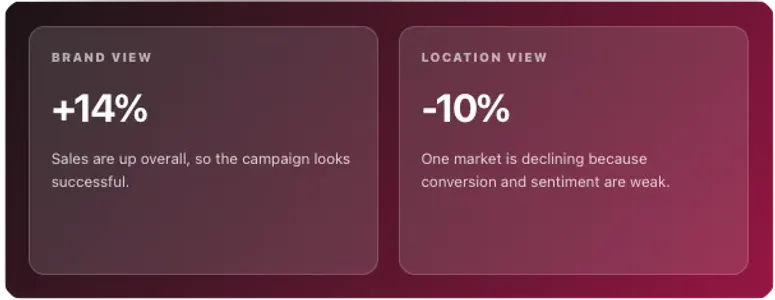
For franchise systems, the problem becomes more sensitive. Franchisees want to know what marketing did for their specific location, not only what happened across the brand. Growth Intelligence helps corporate teams explain local performance in a clearer, more accountable way.
Common restaurant growth pain points this solves
1. “Meta says performance is good, but sales are flat.”
This usually means platform metrics are being reviewed without enough sales context. Reach, clicks, and conversions matter, but restaurants need to connect them to orders, revenue, AOV, new customers, returning customers, and location lift.
2. “Franchisees say marketing is not helping their store.”
This often happens when reporting is too brand-level. A multi-location brand needs local proof: which campaigns ran, which channels grew, what sales changed, and whether the location had operational, review, or menu issues.
3. “We are posting on social, but we do not know if it matters.”
Social activity should be read against sales periods, offer launches, local engagement, store performance, and customer behavior. The question is not only whether people liked the post. The question is whether content helped create demand.
4. “Sales are up, but profit feels worse.”
Growth can be low-quality if it comes mainly from third-party delivery or discount-heavy campaigns. A restaurant needs to understand channel mix, first-party ordering, AOV, repeat behavior, and margin pressure.
5. “We know there is a problem, but not who should fix it.”
This is where Growth Intelligence becomes valuable. It helps decide whether the fix belongs in media buying, Restaurant SEO, CRM Management, Restaurant Email Marketing, Digital Merchandising, or operations.
Growth Intelligence should not stop at insights
A report is only useful if it leads to action. That is why Growth Intelligence should connect directly to execution services.
If the analysis shows a paid media problem, the next step may be better campaign strategy. If it shows weak local discovery, the next step may be Restaurant SEO. If returning customer revenue is weak, the answer may be CRM Management or Restaurant Email Marketing. If the issue is menu conversion, Digital Merchandising may be the right fix.
Growth Intelligence
Connect the signals and understand what is blocking restaurant growth.
Media Buying
Improve spend allocation, campaign strategy, creative performance, and paid growth.
Restaurant SEO
Improve local discovery, organic traffic, Google visibility, and demand capture.
CRM Management
Use guest data, segments, loyalty behavior, and repeat-order signals to grow retention.
Restaurant Email Marketing
Bring guests back with win-back, second-order, loyalty, and repeat-order campaigns.
Digital Merchandising
Improve menu presentation, offer structure, product visibility, bundles, and AOV.
Examples for QSRs, franchises, and restaurant groups
QSR brand example
A QSR brand sees strong lunchtime sales but weak dinner growth. Growth Intelligence can compare daypart sales, ad timing, menu offers, local competition, social activity, and customer segments to decide whether the fix is a dinner offer, campaign change, app push, or local SEO support.
Franchise brand example
A franchisee says campaigns are not helping. Growth Intelligence can show whether local impressions increased, whether orders changed, whether reviews are hurting conversion, whether the menu is underperforming, and whether competitors are more visible in that market.
Multi-brand restaurant group example
A restaurant group wants to know which brand deserves more budget. Growth Intelligence can compare sales growth, channel mix, customer retention, campaign efficiency, sentiment, and market opportunity across the portfolio.
How to start building Growth Intelligence
Restaurants can begin with a simple process:
- Choose the business question first: sales growth, repeat orders, ad efficiency, weak locations, or channel mix.
- Collect the right signals from POS, ads, GA4, social, reviews, menu data, and customer systems.
- Compare performance by location, channel, campaign, customer type, and time period.
- Identify whether the issue is demand, conversion, retention, reputation, menu, or operations.
- Turn the finding into an action plan with clear ownership.
Want a 360° restaurant growth audit?
tossdown can read your performance across marketing, sales, customer behavior, menu, sentiment, and location data.
Frequently asked questions
Is Growth Intelligence the same as analytics?
No. Analytics usually shows what happened. Growth Intelligence connects multiple signals and explains why performance changed and what action should happen next.
Who needs restaurant Growth Intelligence?
It is most useful for QSRs, franchise systems, multi-location restaurants, fast casual brands, cafés, and restaurant groups that have multiple channels, campaigns, locations, and stakeholders.
Can this help with ad spend decisions?
Yes. It helps compare paid media performance against real restaurant outcomes such as sales, orders, AOV, first-party revenue, customer behavior, and location-level lift.
Can this explain why one location is underperforming?
Yes. A strong growth read can compare the location against ads, social activity, reviews, menu performance, local competition, channel mix, and sales trends.
Does tossdown only identify the gap?
No. tossdown can also help solve the gap through connected services like Growth Intelligence, Media Buying, Restaurant SEO, CRM Management, Restaurant Email Marketing, and Digital Merchandising.